
Fallen Angel Names
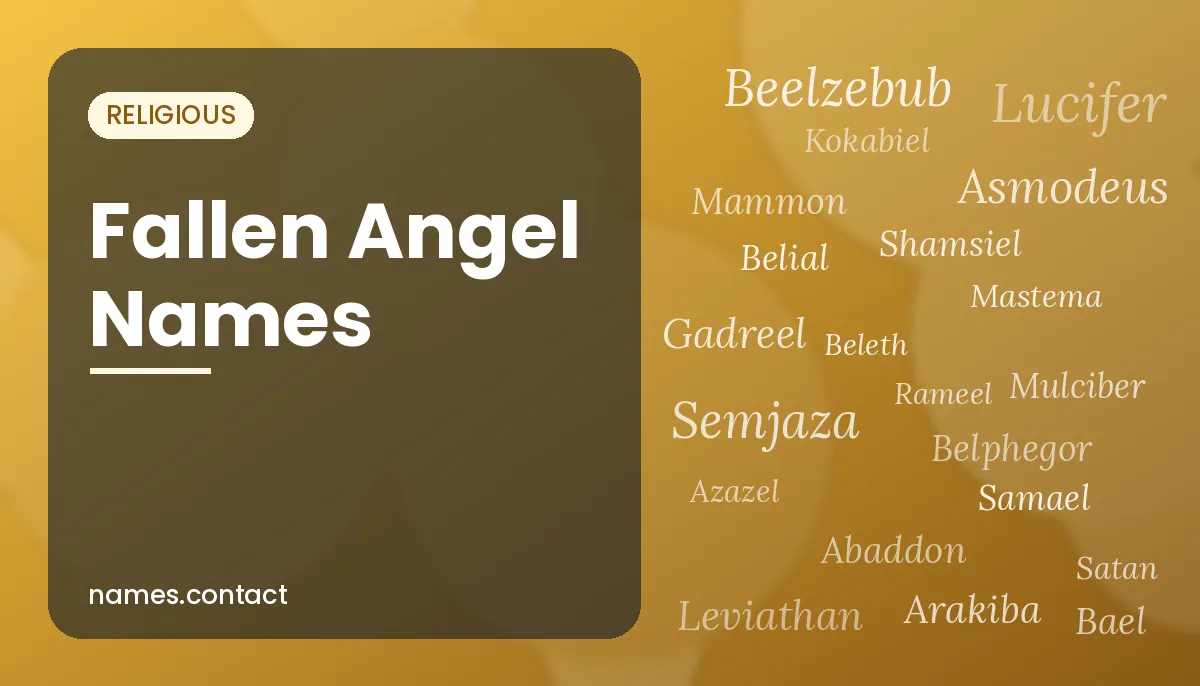
The idea of angels who rebelled against God grew over centuries. The Hebrew Bible barely touches it; the Book of Enoch tells of two hundred “Watchers” who came down to earth; the New Testament speaks of Satan “fallen like lightning” (Luke 10:18); and later writers — from medieval demonologists to John Milton in Paradise Lost — gave the rebel host names, ranks and personalities.
This list gathers more than 90 fallen angel names from those sources, with each name’s meaning and where it comes from, plus a set of original names for writers and gamers. For the loyal side of heaven, see our archangel names and angel names; for pure fiction, try demon names.
The most famous fallen angels
These are the names most people know, drawn from scripture and the traditions that grew around it. Many began as titles or descriptions and only later became personal names.
| Name | Meaning / origin | Role / source |
|---|---|---|
| Lucifer | Latin “light-bearer,” the morning star | Isaiah 14:12 in the Vulgate; later identified with Satan |
| Satan | Hebrew “adversary, accuser” | The accuser in Job 1–2; the dragon cast down in Revelation 12:9 |
| Beelzebub | From Baal-zebub, “lord of the flies” | God of Ekron (2 Kings 1:2); “prince of demons” in Matthew 12:24 |
| Belial | Hebrew “worthless” | 2 Corinthians 6:15; leader of the Sons of Darkness in the Dead Sea Scrolls |
| Abaddon | Hebrew “destruction” (Greek Apollyon) | Angel of the bottomless pit, Revelation 9:11 |
| Azazel | Meaning debated | The scapegoat ritual of Leviticus 16; taught weapon-making in 1 Enoch 8 |
| Samael | Often read as “venom of God” | Accuser and angel of death in the Talmud and midrash |
| Mastema | Hebrew “hostility” | Chief of evil spirits in the Book of Jubilees |
| Satanail | Slavonic form of Satan | Leads a rebellion of angels in 2 Enoch 29 |
| Mephistopheles | Meaning uncertain | The demon of the Faust legend (Marlowe, Goethe) |
| Iblis | Possibly from Greek diabolos | Refused to bow to Adam (Qur’an 2:34); Qur’an 18:50 calls him one of the jinn |
| Harut | Arabic name of uncertain origin | One of two angels in Babylon who taught magic as a test (Qur’an 2:102) |
| Marut | Arabic name of uncertain origin | Harut’s companion; later legend says both were punished for sinning |
The princes of hell and Milton’s rebel angels
In 1589 the theologian Peter Binsfeld matched a demon to each of the seven deadly sins: Lucifer (pride), Mammon, Asmodeus, Leviathan, Beelzebub, Satan (wrath) and Belphegor. In Paradise Lost (1667) John Milton turned the old gods of Israel’s neighbors into Satan’s captains.
| Name | Meaning / origin | Role / source |
|---|---|---|
| Mammon | Aramaic “wealth” | Greed (Matthew 6:24); in Milton, the angel who mines heaven’s gold |
| Asmodeus | Probably from Avestan aeshma-daeva, “demon of wrath” | Lust; the demon of the Book of Tobit |
| Leviathan | Hebrew “twisted, coiled” | Envy; the sea monster of Job 41 and Isaiah 27:1 |
| Belphegor | From Baal-Peor, a Moabite god | Sloth (Numbers 25:3) |
| Moloch | From Hebrew melekh, “king” | Canaanite god (Leviticus 18:21); argues for open war in Paradise Lost Book 2 |
| Chemosh | Name of the Moabite god | 1 Kings 11:7; one of Milton’s fallen host |
| Baalim | Hebrew plural of Baal, “lords” | The many local Baals, listed by Milton |
| Thammuz | From the Mesopotamian god Tammuz | Mourned in Ezekiel 8:14; in Paradise Lost Book 1 |
| Dagon | Philistine god, possibly “grain” | Judges 16:23; his statue falls before the Ark (1 Samuel 5) |
| Rimmon | Hebrew “pomegranate”; god of Damascus | 2 Kings 5:18; a fallen angel in Milton |
| Osiris | Egyptian god of the afterlife | Named by Milton among the fallen angels |
| Mulciber | Latin epithet of Vulcan | Architect of Pandemonium, Satan’s palace, in Paradise Lost |
| Adramelech | God of the Sepharvites (2 Kings 17:31) | Rebel angel wounded by Uriel in Paradise Lost Book 6 |
| Arioch | A king’s name in Genesis 14 | Rebel angel in Paradise Lost Book 6 |
| Ariel | “Lion of God” | Rebel angel defeated by Abdiel in Paradise Lost Book 6 |
| Nisroch | Assyrian god (2 Kings 19:37) | Rebel angel in Paradise Lost Book 6 |
The Watchers: leaders named in 1 Enoch 6
According to 1 Enoch 6, two hundred angels called Watchers descended on Mount Hermon, took human wives and fathered the giants (the Nephilim of Genesis 6:4). Semjaza led them, with these chiefs of ten. Spellings follow R.H. Charles’s 1912 translation; meanings are scholars’ best readings.
| Name | Likely meaning | Note |
|---|---|---|
| Semjaza | Possibly “my name has seen” | Leader of the Watchers (also Shemihazah) |
| Arakiba | Meaning uncertain | Chief of ten |
| Rameel | Meaning uncertain | Chief of ten |
| Kokabiel | “Star of God” | Taught the constellations (1 Enoch 8:3) |
| Tamiel | Possibly “perfection of God” | Chief of ten |
| Ramiel | Possibly “thunder of God” | Also a rebel angel in Paradise Lost |
| Danel | “God has judged” | Chief of ten |
| Ezeqeel | Possibly “strength of God” | Taught the knowledge of the clouds |
| Baraqijal | “Lightning of God” | Taught astrology |
| Asael | “God has made” | Often identified with Azazel |
| Armaros | Meaning uncertain | Taught how to break enchantments |
| Batarel | Meaning uncertain | Chief of ten |
| Ananel | “Cloud of God” | Chief of ten |
| Zaqiel | Meaning uncertain | Chief of ten |
| Samsapeel | “Sun of God” | Chief of ten |
| Satarel | Possibly “hidden of God” | Chief of ten |
| Turel | Possibly “rock of God” | Chief of ten |
| Jomjael | “Day of God” | Chief of ten |
| Sariel | “Moon of God” in this context | Taught the course of the moon |
More Watchers and rebels from Enoch and Jewish legend
1 Enoch 8 and 69 name further Watchers and the forbidden knowledge they gave humanity. Later Jewish legend adds the angels Uzza and Azza, who objected to humankind.
| Name | Meaning / origin | Role / source |
|---|---|---|
| Araqiel | “Earth of God” | Taught the signs of the earth (1 Enoch 8:3) |
| Shamsiel | “Sun of God” | Taught the signs of the sun |
| Gadreel | Possibly “wall of God” | Led Eve astray and showed humans weapons (1 Enoch 69:6) |
| Penemue | Meaning uncertain | Taught writing with ink and paper (1 Enoch 69:8) |
| Kasdeja | Meaning uncertain | Taught harmful arts against spirits (1 Enoch 69:12) |
| Yeqon | Possibly “inciter” | Led the other angels astray (1 Enoch 69:4) |
| Asbeel | Possibly “deserter from God” | Gave the angels evil counsel (1 Enoch 69:5) |
| Uzza | Hebrew “strength” | Protested Enoch’s elevation in 3 Enoch |
| Azza | Hebrew “strong” | Named with Uzza and Azael in 3 Enoch |
Fallen angels in the Goetia
The Ars Goetia, a 17th-century grimoire in the Lesser Key of Solomon, lists 72 spirits. Several are described as former members of angelic orders, and some still hope to return to heaven. Fantasy fans will find more in our dark names and evil names lists.
| Name | Rank in the Goetia | Note |
|---|---|---|
| Bael | King | The first spirit listed; his name comes from Baal |
| Paimon | King | Rides a dromedary; said to be very obedient to Lucifer |
| Beleth | King | Rides a pale horse to the sound of trumpets |
| Vine | King and Earl | Appears as a lion on a black horse; reveals hidden things |
| Balam | King | Has the heads of a bull, a man and a ram |
| Zagan | King and President | Can turn water into wine |
| Purson | King | Lion-faced; said to be partly of the order of Virtues and Thrones |
| Astaroth | Duke | A demonized form of the goddess Astarte |
| Focalor | Duke | Hopes to return to the Seventh Throne after 1,000 years |
| Phenex | Marquis | Appears as a phoenix; hopes to return to the Seventh Throne |
| Marchosias | Marquis | A winged wolf who also hopes to return to the Seventh Throne |
| Murmur | Duke and Earl | Said to be partly of the order of Thrones and Angels |
| Raum | Earl | Appears as a crow; said to be of the order of Thrones |
| Crocell | Duke | Said to be of the order of Powers |
| Gaap | President and Prince | Said to be of the order of Powers |
| Stolas | Prince | Appears as an owl and teaches astronomy and herbs |
| Andras | Marquis | An angel’s body with a raven’s head, riding a wolf |
Fallen angels in later grimoires
The Grand Grimoire (18th–19th century) organized hell like a royal court under Lucifer, Beelzebub and Astaroth. The much older Testament of Solomon adds a fallen spirit of its own.
| Name | Meaning / origin | Role / source |
|---|---|---|
| Lucifuge Rofocale | Latin-French “one who flees the light” | Prime minister of hell in the Grand Grimoire |
| Satanachia | From Satan | Commander-in-chief of hell’s armies |
| Agaliarept | Meaning uncertain | A general of hell who reveals secrets |
| Fleurety | French-sounding, meaning uncertain | Lieutenant general |
| Sargatanas | Meaning uncertain | Brigadier who can make people invisible |
| Nebiros | Possibly from the god Nebo | Field marshal and inspector general |
| Abezethibou | Meaning uncertain | One-winged spirit who once sat in the first heaven (Testament of Solomon) |
Original fallen angel names for stories and games
Need a name that isn’t already loaded with history? These invented names follow the classic Hebrew “-el” pattern (“of God”) with a darker twist. For more, see our villain names and names that mean shadow.
| Name | Style / vibe | Best for |
|---|---|---|
| Vesperiel | Twilight, melancholy grace | A tragic, sympathetic rebel |
| Morthael | Cold and final | An angel of death gone rogue |
| Nyxariel | Night-born, mysterious | A spy or assassin |
| Caelruin | “Heaven’s ruin” | A fallen general |
| Ashkiel | Burned and bitter | A scarred warrior |
| Seraveth | Once-seraphic, now hollow | A former high-ranking angel |
| Malzariel | Regal and menacing | A prince of a hellish court |
| Orivane | Proud, elegant | A charismatic tempter |
| Duskael | Soft-spoken shadow | A reluctant rebel |
| Ithuriel’s Shade | Echoes the loyal angel Ithuriel from Paradise Lost | A dark twin or doppelgänger |
| Zerathiel | Sharp and ancient | A keeper of forbidden lore |
| Kalveth | Short and hard | A mercenary fallen angel |
| Nephariel | From “nefarious” | A scheming villain |
| Solvane | Faded sunlight | An angel who fell for love |
Using fallen angel names
- Check the source. Names from 1 Enoch, Milton and the Goetia each carry a different history. Knowing which one you’re borrowing from adds depth to fiction.
- Mind the meanings. Many fallen angels keep the “-el” ending, meaning “of God” — a nice irony writers often lean into.
- Be thoughtful with baby names. Names like Lucifer, Azazel or Samael carry heavy associations. Ariel is a gentler option that also appears on the loyal side of heaven.
- Respect living faiths. Figures like Iblis, Harut and Marut are part of Islamic belief, and the Watchers are scripture for the Ethiopian Orthodox Church. Treat them with care.
- Go original for games. If you need a name nobody can look up, adapt the -el or -iel pattern like the invented names above.
Frequently asked questions
Who was the first fallen angel?
In Christian tradition Lucifer, identified with Satan, is the first and leader of the fallen angels. In 1 Enoch the rebellion is led by Semjaza, with Azazel as the most prominent teacher of forbidden knowledge.
What are the names of the fallen angels in the Bible?
The Bible names very few: Satan, Abaddon/Apollyon (Revelation 9:11) and, by later interpretation, Lucifer (Isaiah 14:12). Beelzebub and Belial also appear as names for Satan or demonic powers. Most other names come from 1 Enoch and later tradition.
What were the Watchers?
In 1 Enoch, the Watchers were 200 angels who descended to Mount Hermon, married human women and taught forbidden arts such as weapon-making and astrology. Their children were the giants, linked to the Nephilim of Genesis 6:4.
Is Azazel a fallen angel?
Azazel appears in Leviticus 16, where a goat is sent “to Azazel” on the Day of Atonement. In 1 Enoch he is a Watcher who taught people to make weapons and jewelry and is bound in the desert as punishment.
What does Lucifer mean?
Lucifer is Latin for “light-bearer.” It translates the Hebrew “Helel ben Shahar” (shining one, son of the dawn) in Isaiah 14:12, originally a taunt against the king of Babylon.
How many fallen angels are there?
Revelation 12:4 says the dragon’s tail swept “a third of the stars of heaven,” which many readers take to mean a third of the angels fell. 1 Enoch counts 200 Watchers.